Voice for hands-busy work: conversation on the shop floor
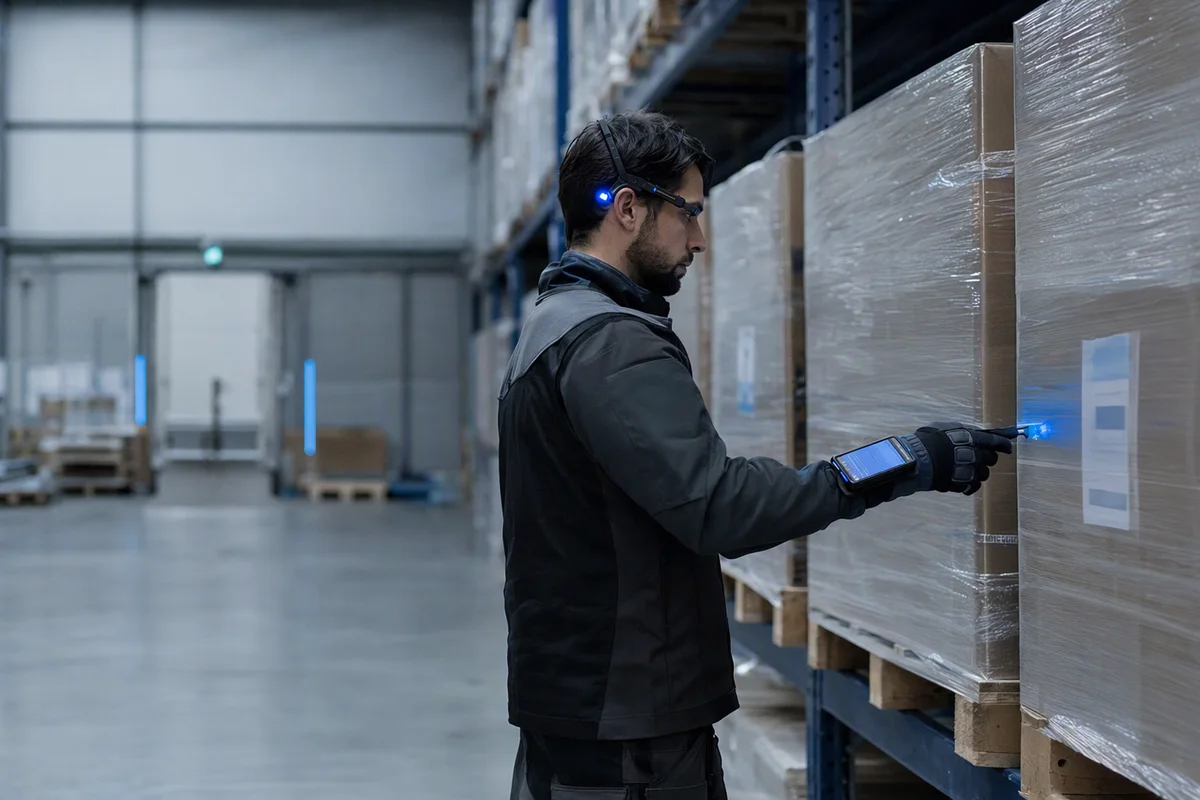
A picker in a warehouse is wearing gloves, has a scanner on the wrist and a pallet on a hand truck. A label is damaged and will not scan. The system wants a manual confirmation on a terminal mounted on a pillar several metres away. The picker parks the truck, takes off a glove, taps through three screens, puts the glove back on and walks back.
A service technician is kneeling by a machine at a customer’s site. The question is simple: when was this unit last serviced, and which part was replaced? The answer is in the system. The tablet is in the van.
Neither of these is a software bug. The interface assumes a desk, and a large share of a company’s work does not happen at one. It happens standing, walking, carrying, with both hands occupied. For that work, voice is not a novelty. It is the only channel still free.
Voice in the warehouse is not new either: voice-directed picking, with fixed commands and check digits read aloud at each location, has been used for years. What has changed is that speech recognition and language models can now handle free questions, not just a fixed command set. That makes voice more useful, and easier to get wrong.
Where voice at work fails
Noise. Forklifts, compressors, extraction fans, wind, a radio. Recognition that works in an office fails on the floor. The only test that counts is in the actual place, at the actual time of day.
Free speech for fixed actions. Confirming a pick should be a short fixed phrase with a check value, not a conversation. A free-form sentence is easier to say and easier to misunderstand.
No read-back. The wrong quantity is heard, so the wrong quantity is booked. Every write to the record needs a confirmation the person can hear and correct.
A system that does not know the context. “Which one is this?” can only be answered if the system knows where the person is, which task they are on and which item they just scanned.
Microphones that hear everyone. An always-on microphone records colleagues as well as the user. Employee monitoring rules and data protection law apply. What is recorded, where it is processed and how long it is kept has to be decided and explained to people before the first headset is handed out.
One language assumed. Many workforces speak several languages, with a range of accents. Recognition has to be tested with the people who will actually use it.
What works
Two modes, kept apart. Fixed, short commands for transactions such as confirming, booking and counting, each with a check value. Free questions for information: when was this unit last serviced, where is the replacement part, what does this error code mean.
Context first. The system knows the task, the location and the item, and interprets every question within that context. “How many are left?” means of this item, at this location.
Read back before writing. “Booking twelve units of the item ending 4471 to location B7. Confirm?” Nothing changes in the record until the person says yes.
Proposals for anything unusual. A damaged label described by voice becomes a drafted non-conformance with a photo, waiting for a supervisor’s approval, rather than a free-text note nobody reads.
Local processing where possible. Speech recognition can run on local hardware, which keeps staff voices inside the company and removes the network from the critical path. The reasoning is the same as in deciding which data must never leave the building.
The same record, a different way in. Voice should be an interface onto the same model, the same permissions and the same approvals as the screen, not a separate application with its own copy of the truth. The general case is made in a chat window is not a conversational interface.
Hurukan is designed so that any way of working with the system, whether a screen, a conversation in the tools people already use, or speech, reaches the same record and the same approval rules of the Agentic Logic layer. The work that would benefit most is described on the Inventory and Logistics page (receipts, issues, counts) and the Operations and Quality page (inspections and non-conformances). The system is in build.
A test you can run today
Spend one hour beside a person whose hands are busy: a picker, a technician, someone at a packing station. Make a mark every time they stop, put something down, or walk to a screen to read or enter something. Next to each mark, note whether they were reading information or recording a transaction.
Then record one minute of ordinary background sound at their workplace on a phone and play it back. That is what any speech recognition will have to work through.
The marks tell you whether voice is worth pursuing there. The split between reading and recording tells you which of the two modes to build first. The recording tells you how hard it will be.
- voice interface
- speech recognition
- warehouse
- field service