One identity for people and agents: who may do what
Agents acting under a shared service account make every action anonymous. Why an agent needs its own identity, delegated from a person, with scopes that expire.
- identity
- permissions
- agents
Five layers, from superintelligence at the top to security and sovereignty at the base.
The whole architectureTen modules covering the whole company, all on one data model and one ontology.
All modulesNotes from building an agentic operating system: ontology, agents, data, sovereignty and models, and the places where the automation deliberately stops.
Agents acting under a shared service account make every action anonymous. Why an agent needs its own identity, delegated from a person, with scopes that expire.
A company operating system needs two memories: the live state modules change every second, and the record of every event, proposal and decision for the audit.
Reading from a system of record is cheap and safe. Writing back is where integrations fail. What has to exist before an agent may write, and where Hurukan draws its line.
How Apache Paimon keeps a table that a stream updates thousands of times an hour, how its merge engines express ontology rules, and what it costs to run.
Apache XTable and Delta UniForm let one record be read as Delta, Iceberg or Hudi without a copy. What they translate, what they do not, where lock-in sits.
Android XR brings Gemini, a camera and agents onto glasses. Before a company rolls them out: what runs on the device, what at the vendor, what in the company's own system.
XREAL Aura puts a camera, a display and Android XR in front of a frontline worker. What it takes for what the glasses see to end up in the company's own record.
Modules take over one process at a time; until then the old ERP keeps writing. How change data capture and Apache Hudi keep the record current meanwhile.
A domain agent needs the company's state as of now, not a nightly copy. How the Data layer keeps it in Apache Paimon, and why agents only propose.
OneLake stores tables as Delta Parquet. What the Delta log gives a company's record, what Microsoft Fabric manages for you, and what remains yours to decide.
Iceberg keeps a table as a tree of immutable metadata with one pointer in a catalogue. Why so many vendors read it, and why the catalogue decides sovereignty.
Who changed what, and what did the agent see when it proposed it? Delta Lake, Iceberg and Hudi answer differently. Choose by catalogue and infrastructure.
Not every task needs a frontier model in someone else's data centre. Small open-weight models on your own hardware handle many narrow jobs well. How to tell which ones.
Superintelligence reads the record constantly, on the company's own hardware. Parquet's layout sets what each question costs: row groups, statistics, codecs.
An event travels between modules as a row with a contract and rests in the record as columns. Why Avro carries the first and Parquet the second.
Retrieval over a pile of documents finds text that looks relevant. Retrieval over a model of the company finds the facts that are true now, together with their relations.
Business software was designed to hold an accurate account of what already happened. That design decision is why a company's speed is set by how fast its staff can type.
Every event between modules is a contract. Apache Avro writes it into the data, and a schema change becomes a proposal a person approves and the system records.
When finance, sales and the board each compute revenue their own way, agents inherit the confusion at machine speed. A semantic layer fixes each definition once, upstream.
Every company knows what its software costs. Almost none can say what the space between the systems costs, and it is usually the larger number.
Workflow engines, RPA bots and language-model agents solve different problems. Choosing by fashion gives brittle bots and unpredictable agents. How to choose by the job.
Borrowing intelligence vocabulary for a business product is easy and mostly harmless. Borrowing the practices those words describe is a criminal offence.
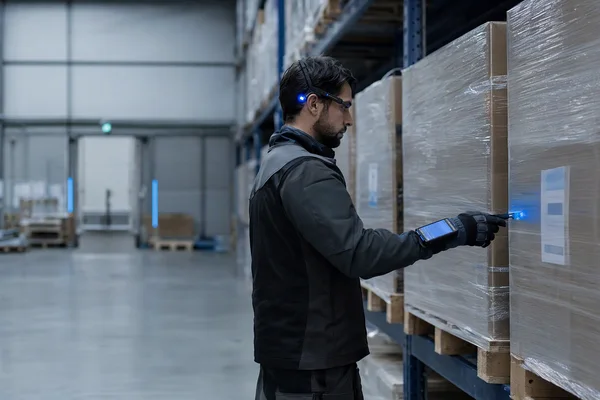
When both hands hold a scanner, a part or a tool, a screen is the wrong interface. What voice has to do to be useful in a warehouse, a workshop or on a service visit.
An autonomous software factory is a real advantage and the easiest thing in this field to oversell. Here is exactly where the automation stops.
A company adds a service line, splits a region or buys a competitor, and its model of the business goes stale. How to change an ontology without breaking what depends on it.
AI work is bursty and hardware sits idle. A grid where machines trade capacity is an old idea whose obstacles were never technical, and there is no token in it.
Treating every record as secret makes the rule unworkable, and treating none as secret makes it pointless. A practical way to classify data before any model touches it.
Asking a chat model how much stock to order produces a fluent number, not a forecast. Demand forecasting is still a job for classical models, a baseline and a backtest.
Language models are strong at reading, drafting and translating between people and systems, and weak at arithmetic, recall and final decisions. A map of where to use them.
Dashboards are built for the questions someone had last year. Managers have new ones every week. Analytics should start from the decision and the question, not the chart.
Each automated step works in the demo, and the process still stalls, because nobody designed what happens between the steps: the handover, the exception and the owner.
Copying every system into one store and pointing a BI tool at it builds a bigger pile, not a platform. A platform is defined by meaning, ownership and a way back to action.
Every company runs on a shared model of customers, orders and exceptions that nobody wrote down. How to find where that model lives and how to get it out of people's heads.
Adding a chat box to business software gives people a new place to type, not a new way to work. A conversational interface needs context, permissions and the right to act.
Moving servers to a local data centre does not make a company sovereign. Who holds the keys, the model of the business and the exit does, and that is decided in the design.