XREAL Aura on the shop floor: the system sees the workstation
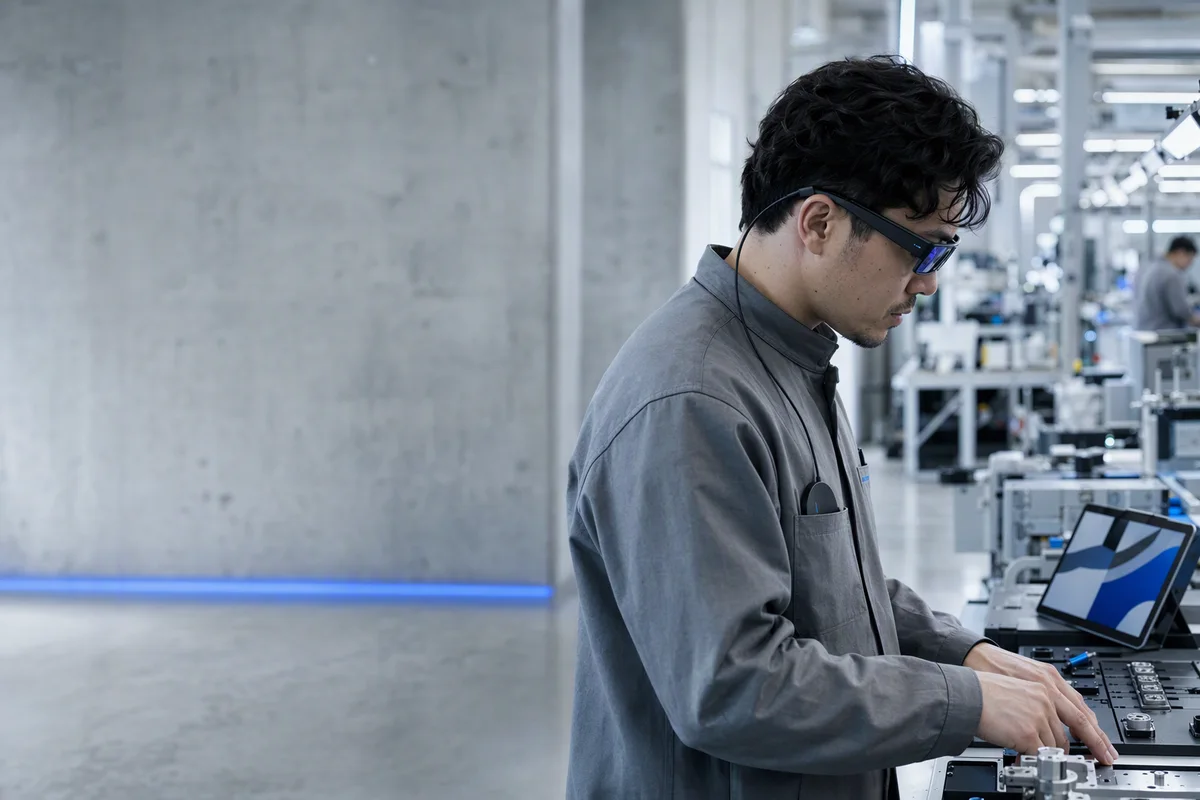
An inspector at an assembly station is checking a batch of housings. The drawing is on a tablet on a stand to her left. The inspection checklist is on a terminal to her right. The non-conformance form is on a PC in the office at the end of the hall. She picks up a part, turns to the drawing, turns back, measures, turns to the checklist, and when one part has a scratch on a sealing face she writes the batch number on a sticky note for later.
A pair of display glasses with a camera could put the drawing and the next checklist step in her field of view, and a model could see the part she is holding. On 7 October 2026 XREAL put a price on exactly that kind of device.
What XREAL Aura is
According to XREAL’s product page, Aura is a pair of optical see-through glasses under 95 g, with a 70° field of view and a Sony micro-OLED display per eye, developed with Google and running Android XR, with Gemini as the built-in assistant. Two tracking cameras follow head and hand movement; a separate high-resolution camera with a privacy light is there for what XREAL calls real-time AI perception. The glasses are connected by cable to a compute puck in the pocket: a Qualcomm Snapdragon chip, the battery, Wi-Fi, GPS and a fingerprint reader.
The launch announcement gives prices from USD 1,279 (12 GB / 256 GB) and USD 1,499 (16 GB / 512 GB). Shipping starts in the United States, Canada, Japan and South Korea, with further markets in 2027. Europe is not in the first wave. For a European company, Aura is today a device to learn from, not one to roll out.
The glasses are not the hard part
A model that sees the bench can describe what it sees. Whether that description is worth anything depends on where it lands: which order, which item revision, which inspection plan, which tolerance, and who may release a deviation. A general assistant knows what a housing is. It does not know your drawing, your batch or your approval rules. Without the company’s record behind it, the most capable glasses give you a clever commentator whose observations disappear at the end of the shift, or stay in a vendor account instead of in the company’s own data.
Where glasses at the workstation go wrong
An assistant without the record. The question at a workstation is rarely “what is this?”. It is “is this one within tolerance for this variant?” That answer lives in the company’s ontology: the order, the item revision, the inspection plan, the work instruction.
Observations that go nowhere. “This one has a scratch”, said aloud, is gone a minute later. It has to become a drafted non-conformance with a photo, tied to the batch, waiting for someone to approve it.
Permissions copied onto the device. If the glasses hold a broad access token, whoever wears them can do whatever the token allows. Permissions belong on the server, checked per person and per action.
A camera that sees everyone. A privacy light tells colleagues when the camera is on. It does not decide what is kept. Employee monitoring rules and EU data protection law apply, so what is recorded, where it is processed and how long it is kept has to be settled and explained before the first pair is handed out.
Not knowing where the work runs. XREAL does not publicly break down which parts of the assistant’s work happen on the puck and which in the cloud. Ask before images of your product and your hall leave the building.
The physical facts. A cable to the pocket, a battery in the puck, gloves, safety eyewear, prescription lenses, dust, a shift that lasts longer than a demo, and a price per seat comparable to a good laptop. Plus, for Europe, the plain fact that it is not on sale yet.
What makes sense instead
Start from tasks with a reading step. Inspection against a drawing, picking with a list, maintenance with a manual, a new person learning a station. Work where someone looks at one thing while reading another is where a display in view earns its place.
Treat the glasses as one more way into the same system. The same ontology, the same permissions and the same approvals as the screen. The glasses show the next step and capture evidence. The record stays where it is.
Superintelligence proposes, a person decides. The model can compare the part with the drawing and propose “possible scratch on sealing face B, batch 2231”. The inspector confirms or rejects. A deviation release still goes to the person with the authority to give it.
Keep evidence, not footage. Store the photo attached to the non-conformance, not the video of the shift. Everything else gets a short retention period, or is never stored at all.
Use the waiting time. A device that is not yet sold in Europe gives you time to get the data ready: item revisions, inspection plans and work instructions in structured form. Any glasses, and any other interface, will need exactly that.
Hurukan is designed so that every way into the system, whether a screen, a conversation, speech, and possibly display glasses like these, reaches the same ontology and the same approval rules in the Agentic Logic layer. Glasses on Android XR are a direction we are thinking about, not something Hurukan runs on today. The platform questions, what runs on the device, what at the vendor and what in the company, are the subject of Android XR as an enterprise endpoint. The same reasoning applied to speech is in voice for hands-busy work, and inspections and non-conformances are described on the Operations and Quality page. The Hurukan homepage shows how the pieces fit together.
A test you can run today
Pick one workstation. For one shift, make a mark every time the person turns away from the work to read something: a drawing, an instruction, a checklist, a screen. Next to each mark, write where that information lives today: in the system, on paper, or in someone’s head.
Then take three photos from roughly where a camera on their glasses would sit, and look at them closely. Which colleagues, which screens and which customer documents are visible?
The marks tell you whether glasses would help at that station. The second column tells you whether your data is ready for them. The photos tell you how much privacy work comes first.
- XREAL Aura
- Android XR
- smart glasses
- frontline work
- quality inspection